Our research explores how AI delegation affects human perception of feedback and responsibility attribution.
- VenueACM CHI 2026 in Barcelona
- Paperdoi.org/10.1145/3772318.3791075
- LabNCCU SITES (Social Intelligence Technologies Experimental Studio)
- RoleFirst author — led the full project (study design, experiment, analysis & writing)
- FieldHuman-Computer Interaction, AI Delegation
- StatusTo be disclosed
Abstract
AI is reshaping workplace dynamics as people increasingly delegate tasks to intelligent assistants. Yet how AI delegates are perceived compared to human delegates—and how their performance and their received feedback shape perceptions—remains unclear. We conducted a 2×2×2 between-subject experiment where participants delegated a scheduling task to either a human or an AI agent, varying their competence (high vs. low) and valence of received feedback (positive vs. negative) toward their performance. Participants generally had higher trust in human assistants; yet a striking asymmetry emerged: when an AI assistant received negative feedback, participants felt the criticism as more self-directed—an "AI Phantom Limb" effect—whereas positive feedback transferred less. This asymmetry did not appear with human delegates. These findings highlight broader design implications, suggesting that AI delegation might blur the boundary between self and other. We also discuss how these findings extend theories of delegation and responsibility attribution to AI.
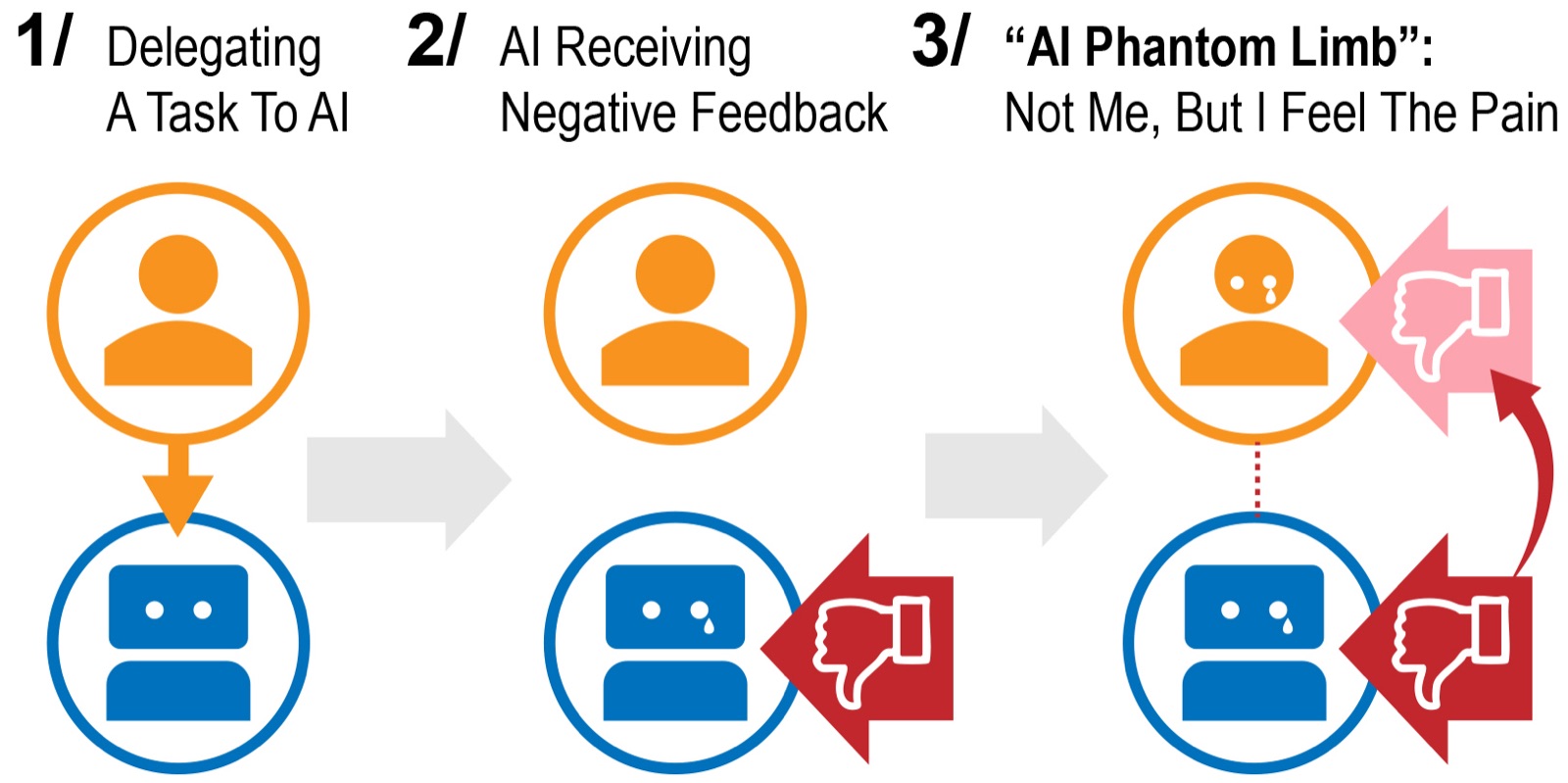
The 2×2×2 between-subjects design (delegate × competence × feedback valence) and the core asymmetry: negative feedback to an AI delegate is felt as more self-directed, while positive feedback transfers less.
Research Context
This work was conducted at the Social Intelligence Technologies Experimental Studio (SITES), a lab/design studio led by Yoyo Tsung-Yu Hou at National Chengchi University (NCCU), Taipei, Taiwan. The lab focuses on how interactive media and technology can be leveraged to create meaningful user experiences, combining design thinking, HCI methodology, and emerging technology exploration.
Why It Matters — Business & Product Impact
As companies race to embed AI copilots and delegated agents into products, this work surfaces a hidden risk for adoption: when an AI delegate is criticized, users internalize the blame as if it were their own—yet they don't equally share in its praise. For product and design teams, that reframes how AI assistant features should handle feedback, error states, and trust calibration to protect user confidence and retention. The finding directly informs enterprise AI rollout strategy, onboarding design, and where human-in-the-loop controls create the most value.