A UX redesign of bar operations for the Good Temper Bar near National Chengchi University, aiming to improve customer retention and operational efficiency through user research and interaction design.
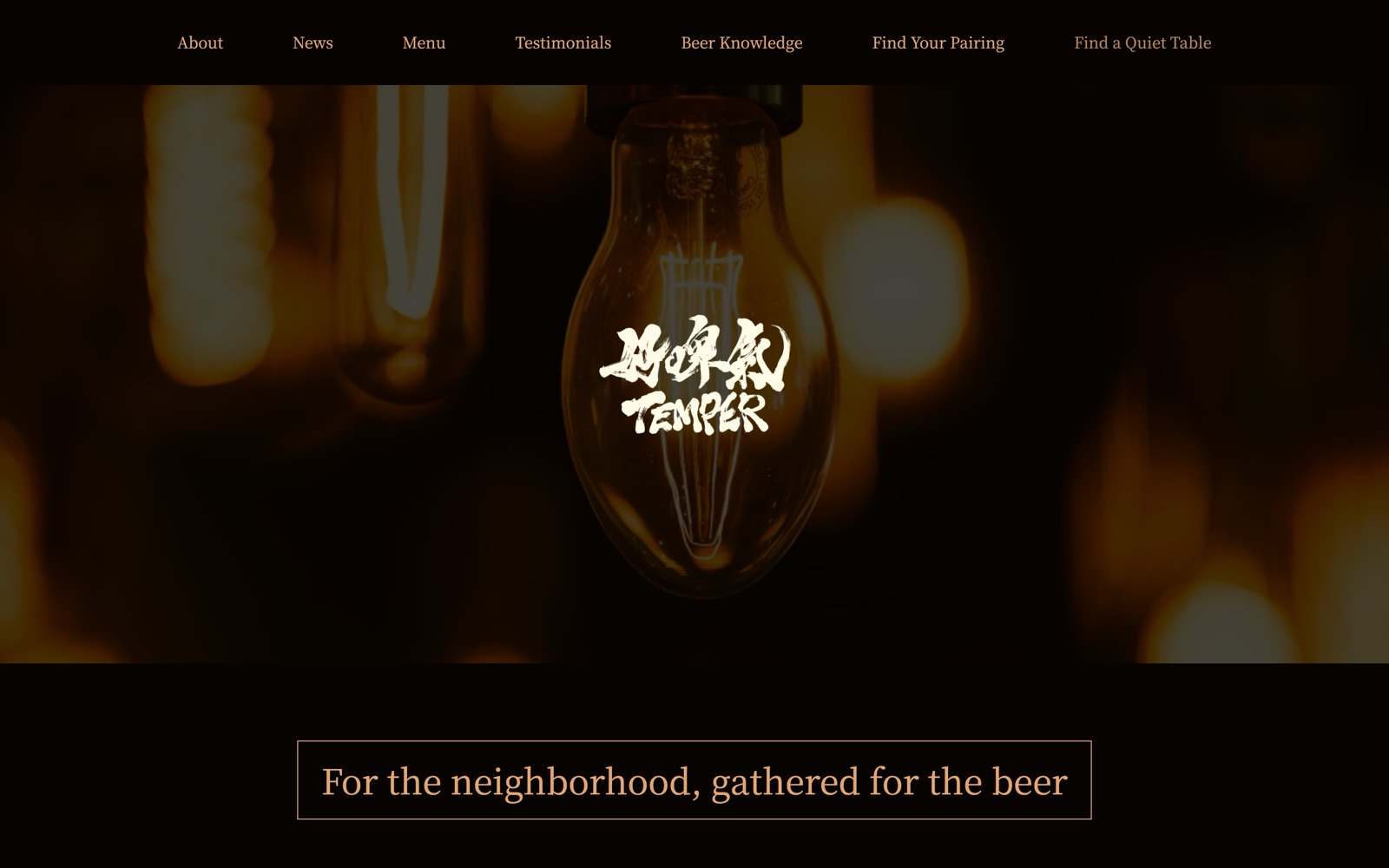
The TEMPER website homepage — the brand's visual identity translated from the physical bar into an online touchpoint.
Role
Group Leader and UX Designer
Timeline
2023.03 ~ 2023.06
Team
4 members
Skills
UX Research · Interaction Design · Figma · Interviews · Participant Observation
Problem
Good Temper Bar's actual customer base skewed the wrong way from its neighborhood-bar positioning, had no consistent online touchpoint, and left capacity idle across a dead 16:00–21:00 window.
What I did
Group Leader and UX Designer. Diagnosed the positioning and operations gap through mixed-methods research, then translated it into a phased roadmap the owner could act on incrementally.
Evidence
4-month mixed-methods study — owner, staff, and customer interviews, participant observation, and a 3-competitor audit.
Status
Roadmap and TEMPER website handed off to the owner; not measured against the baseline metrics after launch.
The TEMPER website is a working brand site. The Find a Quiet Table occupancy levels and Neighbour Hour incentive are illustrative concepts, not connected to a live booking system.
- 18%
- Weekday table-turn rate
- low utilization
- NT$250
- Avg. spend per customer
- ~US$8
- ~30%
- Price premium vs. rivals
- above nearby bars
- ~10
- Avg. likes per social post
- 20–100 range
Baseline metrics surfaced during research — the "before" state the redesign set out to improve.
Challenge
The Good Temper Bar, founded in 2016, positioned itself as a community bar for Wenshan District residents — an affordable, walkable craft beer spot with a casual atmosphere. The owner is passionate about beer culture and wanted to promote craft beer in an area where bars were relatively rare.
However, the bar faced several operational challenges:
- The primary customer base was university students, misaligned with the intended positioning as a neighborhood bar for local residents.
- Bartenders doubled as servers, limiting their ability to interact with and educate customers about craft beer.
- Information was scattered across Facebook and Instagram with no integrated platform for menu, brand story, or product details.
- Located in a residential area, the bar received complaints from neighbors about noise, alcohol sales, and fumes.
- Highly uneven customer traffic across time slots made it difficult to maximize operational efficiency.
Approach
Over four months, my team ran a mixed-methods study — in-depth interviews with the owner, staff, and customers; participant observation and in-store shadowing; and a competitive and operational audit. We structured the work in three stages: diagnosing the business, understanding the people, and translating both into a phased strategy.
1. Diagnosing the business
We started by mapping who actually showed up against who the bar was built for, then benchmarked pricing and promotion against nearby competitors and traced why marketing spend wasn't converting.
Positioning gap. The bar was built as a neighborhood spot for Wenshan-district residents, but the actual core customers were students — the segment with the highest spending power, yet the one furthest from the owner's intended community identity. Product information lived only on Facebook and Instagram, averaging ~10 likes per post, and bartenders doubled as servers with no time to introduce craft beer.
Competitive benchmark. We audited three nearby bars across the 4Ps. 隱 Bistro emerged as the closest rival — nearer to campus, longer hours, and cheaper food.
Good Temper 好啤氣 This project
- Walk
- 5 min
- Hours
- —
- Prices
mains $130 · snacks $150 · soft $130
Hoydea
- Walk
- 12 min
- Hours
- 21:00–2:00
- Prices
cocktails $200 · snacks $120–200
Hoydea vs Good Temper: Farthest from campus and late-night focused — competes on cocktails, not craft beer or food.
Good Temper 好啤氣 This project
- Walk
- 5 min
- Hours
- —
- Prices
mains $130 · snacks $150 · soft $130
隱 Bistro
- Walk
- 2 min
- Hours
- 11:00–1:00
- Prices
food $100 · cocktails $180 · beer $100
隱 Bistro vs Good Temper: The closest rival: nearer to campus, longer hours, and cheaper food — the most direct threat.
Good Temper 好啤氣 This project
- Walk
- 5 min
- Hours
- —
- Prices
mains $130 · snacks $150 · soft $130
後卷
- Walk
- 20 min
- Hours
- 11:00–1:30
- Prices
cocktails $200 · sets $300
後卷 vs Good Temper: A pricier bistro-style venue far from campus — a different occasion, not a head-to-head competitor.
Switch tabs to compare each rival. Source: competitive audit, research slide 02.
Neighbor relations & uneven traffic. Sitting among four residential buildings, the bar drew recurring complaints about alcohol sales, noise, and fumes — weakening its ties to the very locals it wanted to serve. Traffic was highly uneven: a ~18% weekday table-turn rate and a dead 16:00–21:00 window left capacity unused.
The conversion leak. Priced ~30% above competitors, the bar drew exposure through IG campaigns but leaked at conversion — only a 16% in-store turn rate. Tracing an hour of marketing activity showed where prospects fell away.
20
Exposure
30
Consideration
30
Daily customers
NT$250
Avg. spend
16%
Turn rate
2. Understanding the people
From the interviews and observation we built three personas capturing the tension at the heart of the bar: an owner chasing community connection, students who came for atmosphere over beer, and loyal regulars who valued craft and conversation.
The Owner
35
yrs · married, has kids
Community connection · Craft-beer authenticity
Student Customer
~20
yrs · spends up to ~NT$3,000
Relaxed vibe · Low beer knowledge
Loyal Regular
20–40
yrs · arrives after 8pm
Beer flavor · Staff interaction
3. Synthesizing into a journey
We mapped the end-to-end customer journey — before, during, and after the visit — to pinpoint where emotion dipped and which touchpoints offered the highest-leverage opportunities to intervene.
Pre-visit Curious
Actions
• Search Google Maps / social to find a bar
• Check menu & vibe
Touchpoints
Google Maps · Facebook / Instagram
Opportunity
Provide detailed, up-to-date beer and brand info at the discovery stage.
In-store Engaged
Actions
• Enter & order
• Ask about the menu
• Interact with staff & other guests
• Join in-store activities
Touchpoints
Bartenders / staff · Other customers
Opportunity
Build a systematic way to introduce beer and train staff to create atmosphere and interaction.
Post-visit Reflective
Actions
• Check out & leave
• Follow / track posts on social
Touchpoints
In-store posters · Social media pages
Opportunity
Promote regular events and stay in touch to turn one-time guests into regulars.
Outcome
The research converged on a single strategic problem: the bar had no clear online touchpoint communicating its brand value, no consistent service experience, and untapped capacity during slow hours. We sequenced the response into three phases by cost and impact, so the owner could act on the highest-leverage move first rather than take on everything at once:
Experience optimization
Strengthen the on-site experience and lift per-customer orders.
Marketing activities
Run regular, scheduled campaigns that give customers a reason to stay.
Brand building
Launch a website that conveys the brand’s tone and value.
Collect feedback
Consolidate the menu and beer info online so it’s easy to look up.
Staff training
Build a training process for consistent service quality and interaction.
Menu diversification
Add drinks and food that fit the brand to raise reputation and stickiness.
To anchor the short-term move, we designed a brand website — "TEMPER" — as the missing online touchpoint. The visual language echoed the physical space: dim lighting, deep brown and low-saturation tones, thin-bordered geometric shapes, and warm wood textures, carrying the bar's brand story, menu, and craft-beer education online. It brought the brand story, menu, and tasting guidance into one place — the highest-priority gap the research had identified.
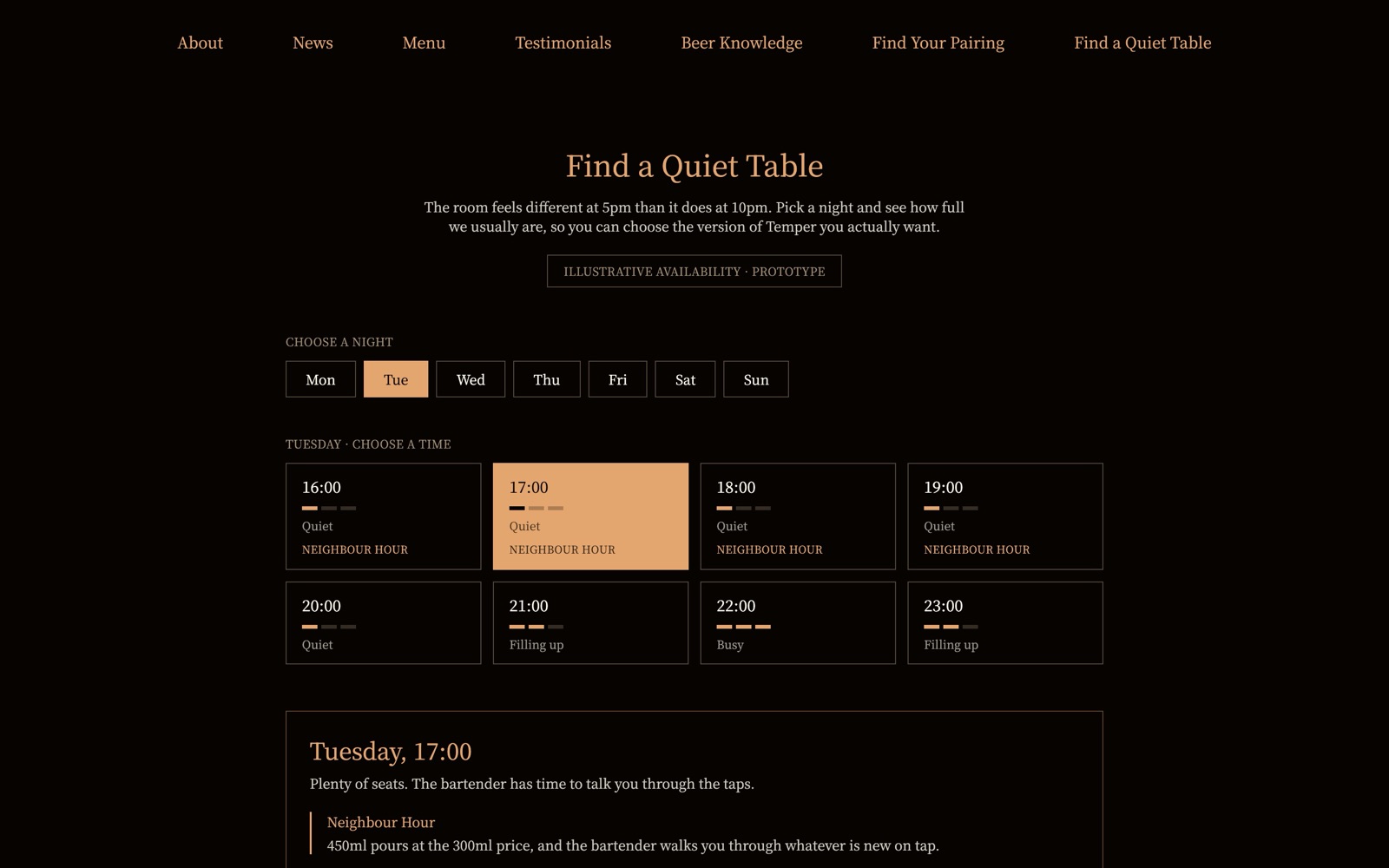
Find a Quiet Table — a direct product response to the ~18% weekday turn rate and dead 16:00–21:00 window the research surfaced, pairing per-slot occupancy with a 'Neighbour Hour' incentive to pull demand into the empty window.
Reflection
The hardest part of this project was getting close enough to observe customer behaviour. Sometimes you have to ask people questions right after they order, or even straight after their drinks arrive.
Understanding the stakeholders — and hearing the operational struggles from the owners and the rest of the staff — was what drove the ideas, and this site: something new part-time waiters could use to introduce the menu, and customers could use to pair their drinks.
We also had to understand the customer personas and their needs from the menu information and the food pairings attached to each beer. Together those built up the picture of what customers needed and what the business needed.