Re-scoping a Contested Building Brief — and Taking 60% Out of Its Cost
Problem
A campus building program was scoped as a space shortage and priced as new construction, against a budget that could not fund it — and three stakeholder groups who could not agree on what to cut.
What I did
Research Leader across 18 people in three sub-teams, operating as the product owner for the brief. I rejected the inherited framing after the research showed the constraint was management rather than square footage, re-scoped the program to repurposing existing space, chose separated circulation over the cheaper shared-path option, and owned the operating model that made the spaces self-funding. When CAD review stalled the decision twice, I swapped the medium for 1:1 cardboard to unblock it.
Evidence
n=350 intake survey (~10% of the target population), shadowing and stakeholder interviews, and an n=20 validation round across six departments.
Status
Unanimous sign-off from students, faculty, and administration; handed to architects as a validated blueprint. The 60% cost reduction is a pre-construction target, not an audited saving.
Challenge
Two interviews before any design work started set the terms of the problem. A junior running a club and juggling internship work had nowhere to hold a small meeting or open a laptop between classes — regular study tables didn't allow group work, and the empty classrooms nearby were either occupied or not open for booking, so he and his teammates worked from off-campus cafés instead, and discussions that ran past 21:00 ended with everyone eating instant noodles back in the dorm because nothing on campus was still open. Two freshmen described the same gap from the other side: no comfortable space existed on campus besides a classroom to sit and talk with friends, the library felt too tense for casual use, and every school event landed in a classroom or the formal assembly hall.
The requirement of the new design for X College would lead to severe congestion during peak hours (e.g. break times), creating dangerous and inefficient bottlenecks in student movement. The redesign was blocked by conflicting interests: school administration with strict budget limitations, professors with operational needs, and nearby residents who utilize campus facilities.
Stated plainly, the decision in front of us was how much building to buy. The brief we inherited assumed new construction, the administration's budget could not cover it, and three groups with different stakes — administrators, professors, residents — each wanted the cut taken somewhere else. My job was to establish what the money should actually buy, get the three groups to agree on it, and hand the architects something fundable.
Role
Research Leader, owning the brief — led 18 people across 3 sub-teams: floor design, stakeholders, and operations
Timeline
2021
Team
18 people in 3 sub-teams, advised by the School President and X College committee at National Chengchi University (政治大學)
Skills
Scoping & Prioritization · Stakeholder Alignment · Business Modeling · Stakeholder Research · Tangible Prototyping
Approach
Quantitative Validation:We distributed surveys via the university's central social hub (NCCU Exchange), gathering responses from 350 students (approximately 10% of the target population). This phase focused on quantifying perception — determining if students were aware of existing facility locations and measuring their expectations for the new layout.
Qualitative Deep-Dive: Through shadowing and in-depth interviews with diverse stakeholders — from freshmen to visiting scholars — we observed actual usage behavior rather than just reported opinions. We identified the paths users attempted to take versus the inefficient routes the architecture forced them into.
Validation round: once a draft proposal existed, we ran a second, later round of short on-site interviews with 20 students across six departments (Diplomacy, Education, Psychology, Sociology, Advertising, Business Administration), checking satisfaction with the draft and what space they still wanted to see added. Individual pod space and café space topped the list (30% each), followed by a nap space (20%) and a dance/rehearsal space and a bar (10% each) — plus freeform requests for a billiards room, a product-photo corner, a shoe dryer, and a real-time discussion space. Individual pods, café, nap rooms, rehearsal rooms, and a rooftop bar all made the final floor plan.
Method note. Three rounds, unevenly documented. The intake survey (n=350) and the validation round (n=20, across the six named departments) both have recorded sample sizes. The validation percentages are shares of the spaces those 20 interviewees mentioned, not of a fixed option list — which is why the freeform requests sit outside the ranked five rather than competing with them. The qualitative shadowing and stakeholder interviews in between are the gap: that round was never written up with a participant count, session count, or observation duration, so it carries no n here.
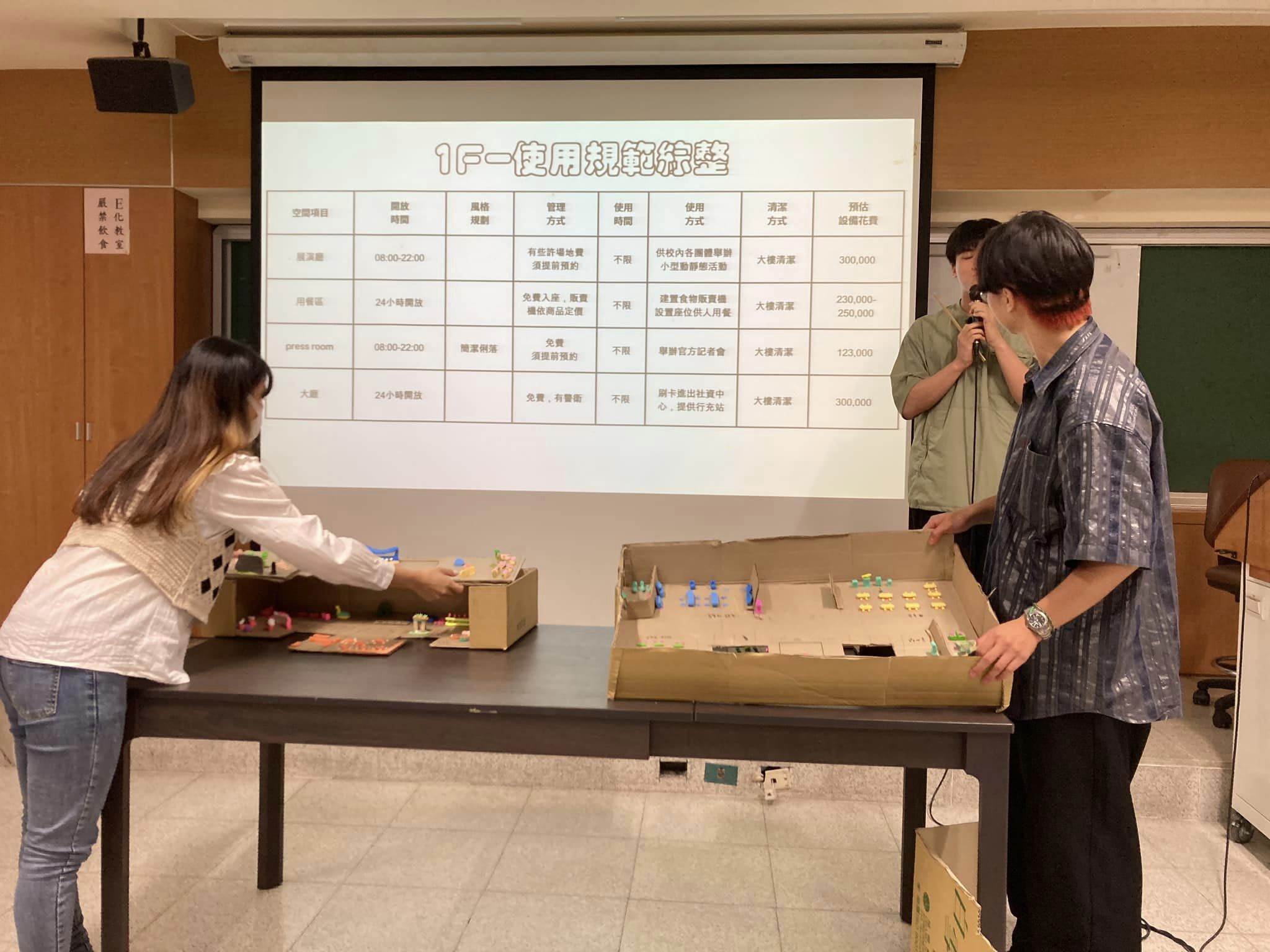
Design Models Presentation
Three findings drove three decisions. This is the part I would point to in an interview: each pairing is a place where the evidence overruled the brief, the cheaper option, or my own first read of the problem — and changed what got funded.
Finding
The "space shortage" was really a management issue — commuter students needed flexible space to gather, dance, and chat, not brand-new rooms.
Decision
Repurpose existing corridors and underused corners instead of building new facilities, aligning the administration’s budget limits with students’ social needs.
Finding
The real barrier was political, not spatial — standard CAD blueprints were too abstract for non-designers, so administrators, professors, and residents could never align on them.
Decision
Replace CAD with 1:1 cardboard prototyping as a shared "boundary object" every stakeholder could read and physically move.
Finding
Simulating peak-break traffic on the physical model exposed the choke points where student rush-hour flow collided with resident and staff use.
Decision
Redesign circulation into separated zones so high-traffic student movement no longer interfered with the quiet resident and staff areas.
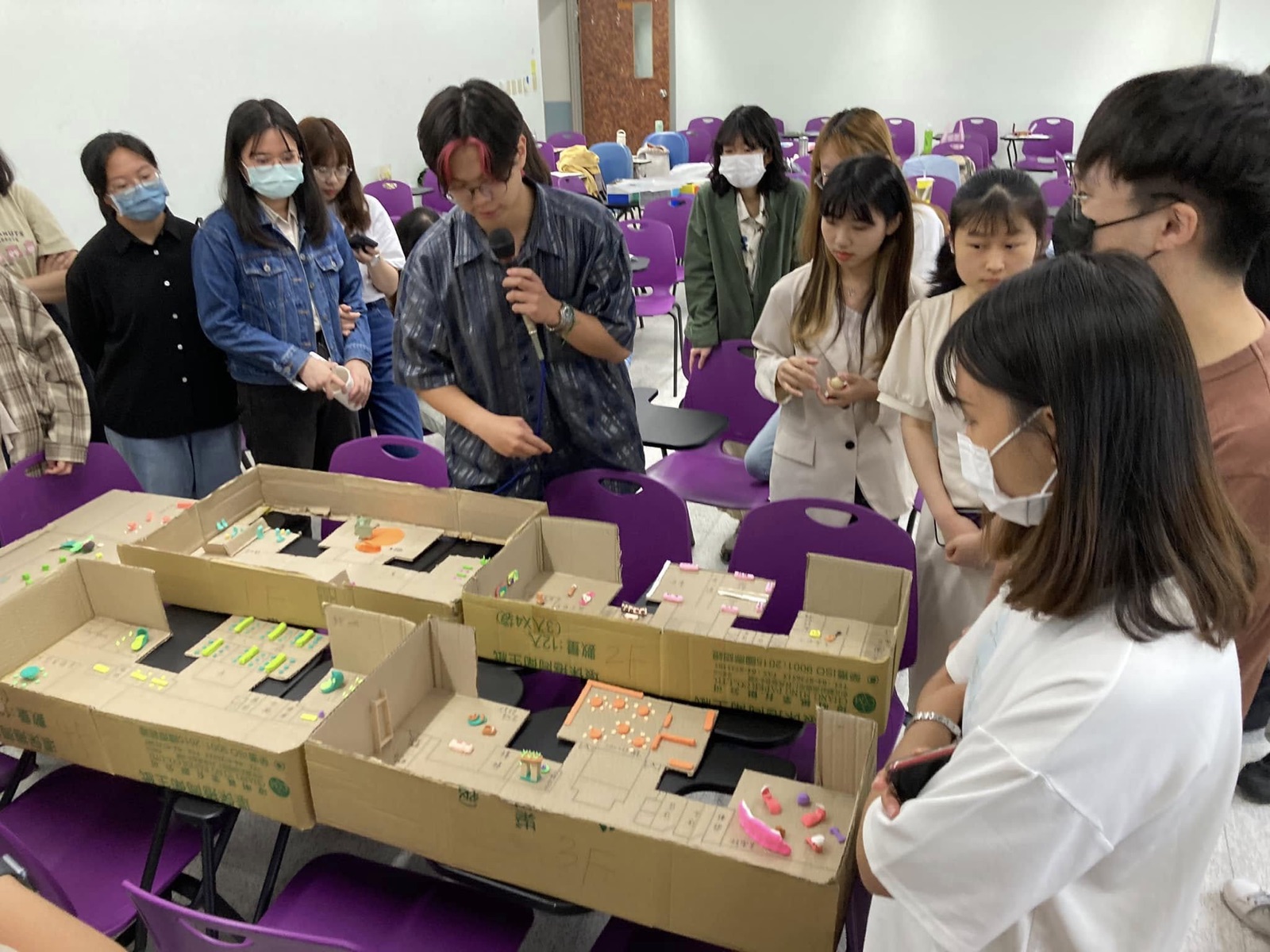
The 1:1 cardboard model as a shared "boundary object" — administrators, professors, and students could move facilities floor-by-floor (2F, 3F labelled) and see the spatial trade-offs together, instead of arguing over abstract CAD blueprints.
The Building
Because the debate was fundamentally spatial, I rebuilt the fieldwork findings as an interactive massing of the building. Each facility we studied is a distinct zone — the entrance choke point, the corridors we reclaimed, the flexible student areas, and the quiet resident zones we separated from rush-hour flow. Hover a facility to locate it on the model, or rotate the model to explore how the pieces relate.
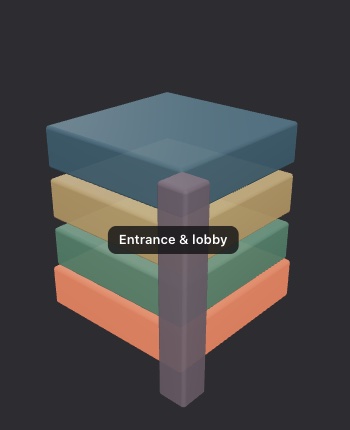
Entrance & lobby
Level 1Choke pointThe ground-floor entrance where student rush-hour traffic converged during break times — the dangerous bottleneck the redesign had to relieve.
Repurposed corridors
Level 2Flexible spaceUnderused corridors and corners reclaimed as flexible social space — solving the "space shortage" without building anything new.
Student flexible zone
Level 3Dance / chatA high-traffic level for commuter students to gather, dance, and chat — the social need fieldwork surfaced behind the "we need more rooms" request.
Quiet resident / staff zone
Level 4Low trafficThe top level kept quiet for residents and staff, deliberately shielded from student rush-hour flow so the two user groups no longer collided.
Separated circulation path
All levelsTraffic flowA vertical circulation spine that split student rush-hour movement from community usage — connecting every floor while keeping high- and low-traffic areas apart.
Load the model to explore the massing — scrolling the findings then lights up the matching floor.
Every room in the explorer carries its own real access, booking, and cleaning rule, not just a label. A few examples: the rehearsal room runs NT$350/hr for outside guests versus NT$250/hr for students, with a further discount for building members; the VR/AR room requires a reservation in 30-minute slots; and the nap floor splits into a quiet zone and a sound-tolerant zone, each capped at a 30-minute session.
Outcome
- 60%
- Negotiated cost reduction
- pre-construction target, not an audited saving
- 100+
- Students at pilot workshops
- drawn by the pilot space design
- 3
- Stakeholder groups aligned
- students · faculty · administration
Research-led results — from a contested debate to a validated, fundable plan.
Status of these outcomes
The 60% figure is a negotiated pre-construction target, not an audited saving. My team's scope ended when the project handed off as a validated blueprint — construction had not started, so there is no built, as-spent cost to measure the estimate against. The 100+ workshop attendance and the 3 aligned stakeholder groups are directly observed; the cost figure is the one number in this set that's a projection, not a result.
Achieved unanimous sign-off from students, teaching staff, and administration. Because we proved the need was for flexible, better-managed space rather than new construction, the architecture firm — after several rounds of negotiation — agreed to a roughly 60% reduction in the projected construction cost. The physical models were then translated into technical specifications for the architects and engineers, moving the project from a contentious debate to a validated blueprint ready for construction.
The business case. Beyond the physical layout, my operations sub-team designed how the building would actually run as a business for students — including usage-fee structures for the student-run flexible spaces — so the repurposed areas could sustain themselves financially instead of becoming a recurring cost to the school. To validate the concept before committing, we piloted the space design in a series of workshops that drew over 100 students, giving the administration real demand evidence to back the plan.
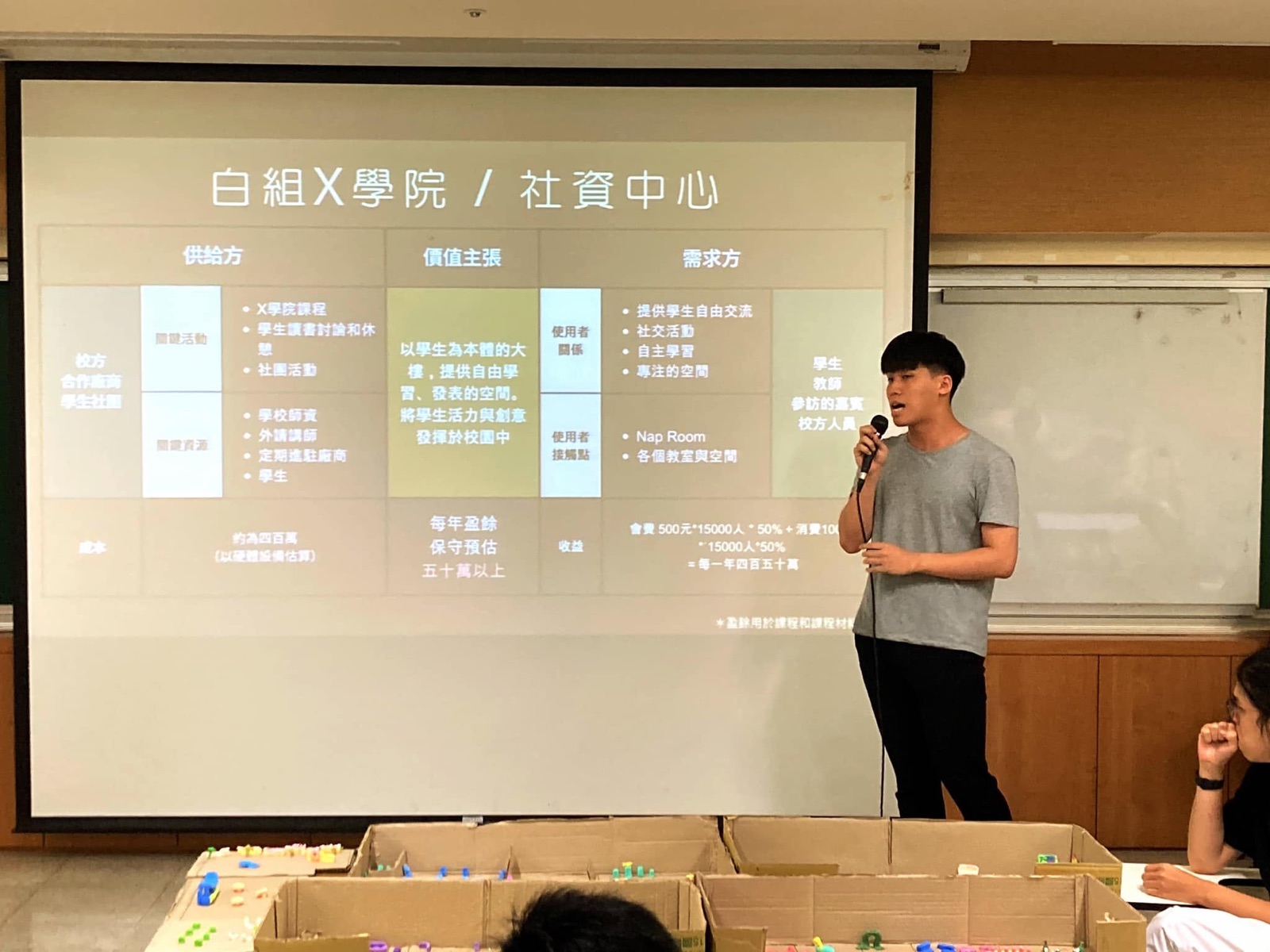
The operating model we designed for the student-run spaces: a membership / usage fee (NT$500 per member) projected to reach ~NT$4.5M in annual revenue against a ~NT$4M cost line estimated from hardware and equipment — a conservative NT$500K+ surplus every year, held across the five-year projection, so the spaces sustain themselves rather than draining the school budget.
The value proposition: a student-centered building offering free space for learning and self-expression, channeling student energy and creativity back into campus life, funded so it doesn't become a recurring cost to the school. The math behind the image above: an annual cost of ~NT$4,000,000, estimated from hardware and equipment, against projected revenue of the NT$500 membership fee × 15,000 eligible students × 50% uptake, plus NT$100 average spend × 15,000 × 50% uptake — roughly NT$4,500,000 a year, for a conservative surplus of NT$500,000+ annually, sustained across the five-year projection and earmarked back into course and workshop materials.
We held role-playing sessions around the physical model. Each team member adopted the persona of a typical user we identified during research. We used Lego figures to physically simulate user journeys, "walking" them through the building to demonstrate how they would interact with the new space.
What We Didn't Build, and Why
New construction. The brief we inherited was framed as a space shortage, and the default response would have been more rooms. Research showed the real constraint was management, not square footage — commuter students needed flexible space to gather between classes, not additional dedicated ones. Recommending new construction would have spent the administration's limited budget solving the wrong problem, so the decision instead was to repurpose existing corridors and underused corners.
A single shared circulation path. Keeping one corridor system for students, residents, and staff alike was the simpler drawing to produce. Simulating peak-break traffic on the physical model showed exactly where that would fail — student rush-hour flow colliding with quiet resident and staff use at specific choke points. We split circulation into separated zones instead, which cost more design iteration but removed the collision the shared-path option would have shipped.
Reflection
The cardboard model is the part people remember, but it was not the first thing we tried. We opened with what seemed like the responsible approach: bring every party to a round table with the architects' CAD blueprints and talk it through. Those sessions went badly. Only the architects and administrators could read the drawings fluently, so professors and residents deferred or objected in general terms, and each meeting re-litigated the same disagreements without resolving any. I initially read that as a stakeholder problem — people being territorial — and pushed for better-facilitated meetings, which didn't help either. It took a couple of stalled rounds to see the drawings themselves were the obstacle: we were asking people to negotiate in a language most of them didn't speak.
The product lesson I took from it is that the most valuable thing I did was refuse the brief. The organisation had already converted a vague complaint into a spec — "we are short on space, build more rooms" — and the budget fight that followed was everyone arguing about how to fund the wrong solution. Re-scoping the problem was worth more than any amount of skill in executing the original one, and it only became arguable because the research made the alternative concrete enough to price.
This project reshaped my understanding of the designer's role in complex systems. I learned that in multi-stakeholder environments, the primary barrier is often not spatial, but political. By choosing low-fidelity cardboard models over high-tech CAD, I discovered that democratizing the design tool is essential for alignment. The model ceased to be just a prototype; it became a boundary object that allowed residents and administrators to speak the same language. Successful strategic design isn't just about creating the solution, but designing the process that allows stakeholders to accept that solution.